Tuesday, 1 December 2020

SAMUEL'S ADVENT: Christmas Before Its Time


He used to live in the shelter at the end of the seafront near the old bathing pool, the shelter in which the Name of Jesus is inscribed. You could see him cycling in that direction, looking happy with himself and he might glance in your direction as he did with me a few days ago. He smiled, I smiled and something within me said, “this man is going to come into your life!” And I wasn’t sure that I wanted him in my life at all.

This beautiful Saturday morning, awake early I decide to open the church in case anyone might want to come in for a candle and a prayer, as Maria sometimes does on her way down to the shop. Today she doesn’t arrive but as I am pottering around the sanctuary getting ready for Advent and listening to Advent music, I notice a man come in. He kneels to pray in the half light and I leave him to it for a while.

Tuesday, 21 August 2018

THE CARPENTER FROM NAZARETH - Fr. Donal McCarthy sac


Balinvreena Hill in South County Limerick looks down on a verdant and fertile plain, not used much for tillage but providing lush grass for the dairy herds so prevalent around. The parish of Bulgaden-Martinstown goes right up to the foot of the hill. This is where I spent many a happy summer as a small child in the late 1940’s and early 1950’s. Things were simple then. One of the parishioners was a man called Patrick Corkery. With his brother “Little Jim” he had a carpenter’s shop and a few acres of land. The house was always a happy place where their sister, Nellie, kept a pot of boiling water over the open fire ready to make a fresh pot of tea for any visitor who came in through the open door.

For a child the shop was a source of wonder and delight. All sorts of things were being made and repaired – doors, windows, wheels for horse-carts, “floats” – hay carts used for drawing in wynds/trams of hay into the barn at the end of the summer.

In the chapel of the Pallottine College in Thurles there is a stained glass window of Jesus and Joseph working in another carpenter’s shop but this time in Nazareth. What was it like? Did they have a sign over the door? “Joseph and Jeshu’a” or even “Joseph and Son”? What did they make? We have some idea from the sayings of Jesus – wooden pitchers for water; tables; chairs; tubs (containers for seeds and foods); and lamp stands. Did they, by any chance, make or repair boats by the Sea of Galilee; make wooden ploughs for farmers; oxen yokes; or frames for carrying two pails of water at the one time? Were they also coopers – making barrels?

It is possible that Joseph and Jesus went from town to town repairing or building houses made of stone. In the speech of Jesus there are building metaphors – “splinter in your brother’s eye”, the “log in your own eye”. He talks about digging firm foundations and “building a house on a solid rock”.

And, while we never think of this, we know that Joseph and Jesus sold things. They got paid for their work; otherwise how could they survive? We don’t think that it is “nice” to think of Jesus handling money but he must have been a good business man. He spoke of coppers, shekels, a denarius, talents and silver pieces.

So the romantic Jesus of our imagination turns out to be a real working man. Not as poor as we always imagined him but honest, hard-working and dependable. Educated by Joseph and the other men of the village, Jesus had an oral knowledge of the Old Testament scriptures and a speaking knowledge of Syro-Aramaic and, most probably, Greek, the commercial language of the Roman Empire.

St. Vincent Pallotti always had a devotion to the “hidden life of Jesus”. In this he gives us a good insight. The sheer ordinariness of the life of Jesus should be an inspiration and an encouragement to us all, especially in these dark days of recession when many young people from our cities, towns and villages, have to leave home to find work. Some of them are our own relatives. Jesus too left home and transferred from Nazareth to Capernaum, where he may have lived in the house of Simon and Andrew or built his own house. To complete his work he needed a new headquarters so that he could be free for the mission given him by his Father.

It is hard to make sense of a mystery. We believe that Jesus came because he loved us.  The Apostle Peter tells us that “evil men” put him to death by hanging him on a tree. Jesus could have used his godly powers to crush those people. That is what we would have done. But he didn’t. Why? Surely he was giving an example for us to follow. Evil is not overcome by counteracting it with more evil. It is only overcome by more and more good acts.

Pope Paul VI in an address on 5 January 1964 stated that the home of Nazareth is the school where we begin to understand the life of Jesus. God in Jesus revealed himself to the world through the use of a place, Nazareth in Galilee. Jesus came at a certain time, 6.00 b.c to 28 a.d. approx. He practised the Jewish life-style and observed its customs. Most probably he spoke with an accent, the rough dialect of the Galileans. He engaged in certain religious practices, pilgrimages to Jerusalem and so forth.

Montini held up for us the value of silence, detachment from the noise of this world, which in turn gives us more time to reflect on spiritual things.  He further went on to praise family life, and stated that the formation received at home is gentle and irreplaceable. The Pope would have liked also to restore the awareness of the nobility of work and its intrinsic value when it is considered in the context of those for whom it is undertaken.  Pope Paul held up Jesus as the model for all the workers of the world. He is truly their brother in God.

Donal McCarthy, S.C.A.

Monday, 20 August 2018

IF ONE MEMBER SUFFERS: Pope Francis


Letter of His Holiness Pope Francis to the People of God

“If one member suffers, all suffer together with it” (1 Cor 12:26). 

These words of Saint Paul forcefully echo in my heart as I acknowledge once more the suffering endured by many minors due to sexual abuse, the abuse of power and the abuse of conscience perpetrated by a significant number of clerics and consecrated persons. Crimes that inflict deep wounds of pain and powerlessness, primarily among the victims, but also in their family members and in the larger community of believers and nonbelievers alike. Looking back to the past, no effort to beg pardon and to seek to repair the harm done will ever be sufficient. Looking ahead to the future, no effort must be spared to create a culture able to prevent such situations from happening, but also to prevent the possibility of their being covered up and perpetuated. The pain of the victims and their families is also our pain, and so it is urgent that we once more reaffirm our commitment to ensure the protection of minors and of vulnerable adults.

1. If one member suffers…

In recent days, a report was made public which detailed the experiences of at least a thousand survivors, victims of sexual abuse, the abuse of power and of conscience at the hands of priests over a period of approximately seventy years. Even though it can be said that most of these cases belong to the past, nonetheless as time goes on we have come to know the pain of many of the victims. We have realized that these wounds never disappear and that they require us forcefully to condemn these atrocities and join forces in uprooting this culture of death; these wounds never go away. The heart-wrenching pain of these victims, which cries out to heaven, was long ignored, kept quiet or silenced. But their outcry was more powerful than all the measures meant to silence it, or sought even to resolve it by decisions that increased its gravity by falling into complicity. The Lord heard that cry and once again showed us on which side he stands. Mary’s song is not mistaken and continues quietly to echo throughout history. For the Lord remembers the promise he made to our fathers: “he has scattered the proud in their conceit; he has cast down the mighty from their thrones and lifted up the lowly; he has filled the hungry with good things, and the rich he has sent away empty” (Lk 1:51-53). We feel shame when we realize that our style of life has denied, and continues to deny, the words we recite.

With shame and repentance, we acknowledge as an ecclesial community that we were not where we should have been, that we did not act in a timely manner, realizing the magnitude and the gravity of the damage done to so many lives. We showed no care for the little ones; we abandoned them. I make my own the words of the then Cardinal Ratzinger when, during the Way of the Cross composed for Good Friday 2005, he identified with the cry of pain of so many victims and exclaimed: “How much filth there is in the Church, and even among those who, in the priesthood, ought to belong entirely to [Christ]! How much pride, how much self-complacency! Christ’s betrayal by his disciples, their unworthy reception of his body and blood, is certainly the greatest suffering endured by the Redeemer; it pierces his heart. We can only call to him from the depths of our hearts: Kyrie eleison – Lord, save us! (cf. Mt 8:25)” (Ninth Station).

2. … all suffer together with it

The extent and the gravity of all that has happened requires coming to grips with this reality in a comprehensive and communal way. While it is important and necessary on every journey of conversion to acknowledge the truth of what has happened, in itself this is not enough. Today we are challenged as the People of God to take on the pain of our brothers and sisters wounded in their flesh and in their spirit. If, in the past, the response was one of omission, today we want solidarity, in the deepest and most challenging sense, to become our way of forging present and future history. And this in an environment where conflicts, tensions and above all the victims of every type of abuse can encounter an outstretched hand to protect them and rescue them from their pain (cf. Evangelii Gaudium, 228). Such solidarity demands that we in turn condemn whatever endangers the integrity of any person. A solidarity that summons us to fight all forms of corruption, especially spiritual corruption. The latter is “a comfortable and self-satisfied form of blindness. Everything then appears acceptable: deception, slander, egotism and other subtle forms of self-centeredness, for ‘even Satan disguises himself as an angel of light’ (2 Cor 11:14)” (Gaudete et Exsultate, 165). Saint Paul’s exhortation to suffer with those who suffer is the best antidote against all our attempts to repeat the words of Cain: “Am I my brother's keeper?” (Gen 4:9).
I am conscious of the effort and work being carried out in various parts of the world to come up with the necessary means to ensure the safety and protection of the integrity of children and of vulnerable adults, as well as implementing zero tolerance and ways of making all those who perpetrate or cover up these crimes accountable. We have delayed in applying these actions and sanctions that are so necessary, yet I am confident that they will help to guarantee a greater culture of care in the present and future.

Together with those efforts, every one of the baptized should feel involved in the ecclesial and social change that we so greatly need. This change calls for a personal and communal conversion that makes us see things as the Lord does. For as Saint John Paul II liked to say: “If we have truly started out anew from the contemplation of Christ, we must learn to see him especially in the faces of those with whom he wished to be identified” (Novo Millennio Ineunte, 49). To see things as the Lord does, to be where the Lord wants us to be, to experience a conversion of heart in his presence. To do so, prayer and penance will help. I invite the entire holy faithful People of God to a penitential exercise of prayer and fasting, following the Lord’s command.1 This can awaken our conscience and arouse our solidarity and commitment to a culture of care that says “never again” to every form of abuse.

It is impossible to think of a conversion of our activity as a Church that does not include the active participation of all the members of God’s People. Indeed, whenever we have tried to replace, or silence, or ignore, or reduce the People of God to small elites, we end up creating communities, projects, theological approaches, spiritualities and structures without roots, without memory, without faces, without bodies and ultimately, without lives. 2 This is clearly seen in a peculiar way of understanding the Church’s authority, one common in many communities where sexual abuse and the abuse of power and conscience have occurred. Such is the case with clericalism, an approach that “not only nullifies the character of Christians, but also tends to diminish and undervalue the baptismal grace that the Holy Spirit has placed in the heart of our people”.3 Clericalism, whether fostered by priests themselves or by lay persons, leads to an excision in the ecclesial body that supports and helps to perpetuate many of the evils that we are condemning today. To say “no” to abuse is to say an emphatic “no” to all forms of clericalism.

It is always helpful to remember that “in salvation history, the Lord saved one people. We are never completely ourselves unless we belong to a people. That is why no one is saved alone, as an isolated individual. Rather, God draws us to himself, taking into account the complex fabric of interpersonal relationships present in the human community. God wanted to enter into the life and history of a people” (Gaudete et Exsultate, 6). 

Consequently, the only way that we have to respond to this evil that has darkened so many lives is to experience it as a task regarding all of us as the People of God. This awareness of being part of a people and a shared history will enable us to acknowledge our past sins and mistakes with a penitential openness that can allow us to be renewed from within. Without the active participation of all the Church’s members, everything being done to uproot the culture of abuse in our communities will not be successful in generating the necessary dynamics for sound and realistic change. The penitential dimension of fasting and prayer will help us as God’s People to come before the Lord and our wounded brothers and sisters as sinners imploring forgiveness and the grace of shame and conversion. In this way, we will come up with actions that can generate resources attuned to the Gospel. For “whenever we make the effort to return to the source and to recover the original freshness of the Gospel, new avenues arise, new paths of creativity open up, with different forms of expression, more eloquent signs and words with new meaning for today’s world” (Evangelii Gaudium, 11).

It is essential that we, as a Church, be able to acknowledge and condemn, with sorrow and shame, the atrocities perpetrated by consecrated persons, clerics, and all those entrusted with the mission of watching over and caring for those most vulnerable. Let us beg forgiveness for our own sins and the sins of others. An awareness of sin helps us to acknowledge the errors, the crimes and the wounds caused in the past and allows us, in the present, to be more open and committed along a journey of renewed conversion.

Likewise, penance and prayer will help us to open our eyes and our hearts to other people’s sufferings and to overcome the thirst for power and possessions that are so often the root of those evils. May fasting and prayer open our ears to the hushed pain felt by children, young people and the disabled.  A fasting that can make us hunger and thirst for justice and impel us to walk in the truth, supporting all the judicial measures that may be necessary. A fasting that shakes us up and leads us to be committed in truth and charity with all men and women of good will, and with society in general, to combatting all forms of the abuse of power, sexual abuse and the abuse of conscience.
In this way, we can show clearly our calling to be “a sign and instrument of communion with God and of the unity of the entire human race” (Lumen Gentium, 1).

“If one member suffers, all suffer together with it”, said Saint Paul. By an attitude of prayer and penance, we will become attuned as individuals and as a community to this exhortation, so that we may grow in the gift of compassion, in justice, prevention and reparation. Mary chose to stand at the foot of her Son’s cross. She did so unhesitatingly, standing firmly by Jesus’ side. In this way, she reveals the way she lived her entire life. When we experience the desolation caused by these ecclesial wounds, we will do well, with Mary, “to insist more upon prayer”, seeking to grow all the more in love and fidelity to the Church (SAINT IGNATIUS OF LOYOLA, Spiritual Exercises, 319). She, the first of the disciples, teaches all of us as disciples how we are to halt before the sufferings of the innocent, without excuses or cowardice. To look to Mary is to discover the model of a true follower of Christ.

May the Holy Spirit grant us the grace of conversion and the interior anointing needed to express before these crimes of abuse our compunction and our resolve courageously to combat them.

Vatican City, 20 August 2018

FRANCIS
______________
1 “But this kind [of demon] does not come out except by prayer and fasting” (Mt 17:21).
2 Cf. Letter to the Pilgrim People of God in Chile (31 May 2018).
3 Letter to Cardinal Marc Ouellet, President of the Pontifical Commission for Latin America (19 March 2016).

Thursday, 16 August 2018

MORNING PRAYER


http://pallottines.ie/union-of-catholic-apostolate/pray-with-us/


Most Holy Trinity
Father, Son and Holy Spirit

We adore and thank you for the blessings received throughout our lives, especially for the gift of this day.

Blessed be the One True God
Father, Son and Holy Spirit.

Most Holy Trinity we offer you through the hands of Mary Queen of Apostles our thoughts, words, works and sufferings of this day.

We renew our resolve to grow to be more perfect in your love so that our community, united by the Love of the Father, the Grace of our Lord Jesus Christ and the fellowship of the Holy Spirit, may be totally committed to the work of the catholic apostolate.

We ask you to assist our Pope Francis and we join with him in prayer for the universal apostolate, for our Christian brothers and sisters, for those who profess a different faith, for those who do not believe in you and for all the peoples of the world.

We entrust our community to your Infinite Love: the individual members and their superiors, the communities, regions and provinces.

Watch over bishops, priests, sisters, brothers and all religious families in your Church.

Bless our relatives, friends and benefactors and all who have asked our prayers.

Through your Infinite Mercy recall to your love all who have strayed; and grant eternal life in  your kingdom to our deceased members and relatives and to all the faithful departed.

Wednesday, 15 August 2018

MOTHER & DAUGHTER: Hands Enfolded


The Grotto in Castlegar - a lovely place to be on a dry, cool August morning. Feast of St. Clare and Autumn seems to have arrived.

We prayed here for a miracle on May 25th - an incredibly beautiful evening - but there was none given. We came here in our youth across the fields when faith was strong and swift.

Now I'm here preparing for the funeral of our neighbour who was 103 years old, whose daughter has been part of our family for over 60 years and I have the honour of being the brother she never had.

No matter what's going on, this place delivers a peace that is to be found in no other grotto, except perhaps Lourdes.


I'm thinking of the days in the hospital. There was a short period of quiet one evening when conversation ceased and I was alone with Mother and Daughter. In the silence I observed both their hands so effortlessly and tenderly enfolded in each other. They didn’t grasp or hold on tightly; they didn't cling but there was reverence and love.

In the hands of these two great women there is the history of what I think of as a legendary life with all its wonder, discovery, its shared struggle and suffering; its laughter and a love that has progressively deepened, a love that has ascended great heights.

And when the Word of God asks us to see what love the Father has lavished on us, we see an expression of such love, we have witnessed it and felt it in them together and in their own individual ways.

Her Mother's faith is core, not just an external function but an interior, unfathomable depth, a deep spiritual well that she was able to draw from when she could no longer read or pray in the way she used to.

It was inspiring to encounter the spirit of prayer that she maintained to the end. She prayed for all of us and she suffered for us, suffered with Christ for us and it is in Him that all her years of suffering has meaning.

The regular visits of the Parish Priest meant an awful  lot to her, were essential part of the care she received and in them she received spiritual sustenance. 

Her bed was a place where the spiritual and the material came together. She held the two worlds together in balance. On one side she had Hello magazine with all its glamour and celebrity and on the other she had her prayers and rosary beads.

To be a person of faith in this life means just that - to hold two different worlds together in balance without losing either one; to be a person of faith is to be a blessing to the world and she did this because she held the blessing within herself, she had the resources. Jesus in Holy Communion was her chief resource, together with His Mother Mary and the saints. By these she blessed us, made us feel better, made us laugh and feel happier.

She gave birth to her Daughter who in time came to mother her, became her safe place, her wellbeing. The evidence of this came a couple of years ago when she was not well in the nursing home so her Daughter  brought her back home and she became well again. She may not have said it in words but her body spoke, her very being became better in the care her child gave her. 

And when the time for parting finally came her Daughter delivered her into Eternal Life by her presence, her love and her prayer. The Word Jesus spoke to her soul, “come you blessed of my Father, inherit the kingdom prepared for you since the foundation of the world.” And in dying she delivered her Daughter again into a new life of her own, a reality emphasised by the fact that the funeral took place on her Daughter's birthday. 

Together they  have run the race, fought the good fight and kept the faith. “Well done good and faithful servant", good and faithful Daughter who gave an exceptional level of care that has inspired all of us beyond what words can express. It cost nothing less than everything. Everything generously and selflessly given.

It was time, the right time and there is a lovely sense of grace but it also leaves her Daughter with a great big empty space that is her's alone to fill. And, while we will accompany her, we should not rush to fill that space for her.


Monday, 4 July 2016

MESSAGE OF POPE FRANCIS FOR JULY 4TH


Dear brother:

I received your petition to unite myself with a few brief words for the Mass that will be celebrated in memory of the Servants of God Alfredo Leaden, Pedro Duffau, Alfredo Kelly, Salvador Barbeito Doval and Emilio Barletti, on the 40th anniversary of their death. I knew Fr. Alfie Kelly personally, a priest who thought only of God and, as you know, I followed his tragedy with a sense of faith, as this is the key to his life, and also to his death.

Remembering these witnesses can be a stimulus for all of us. They present us with a surrendered life, without thought for themselves, that as the servant of the Gospel seeks to be where the Lord is, among the last.

May the Lord Jesus, who called them to this vocation, bless them and the Holy Virgin care for them.
Vatican, 4th July 2016.
                                                                                                    Francis


Friday, 1 July 2016

Belgrano Massacre 40th Anniversary: Press Conference

SÍNTESIS Conferencia de Prensa a 40 Años de la Masacre de los Palotinos
Juntos vivieron y juntos murieron
Hoy son luz y vida

40 AÑOS DE LA MASACRE DE SAN PATRICIO
El jueves 30 de junio de 2016, en la parroquia San Patricio del barrio de Belgrano en la ciudad de Buenos Aires, se llevó a cabo una conferencia de prensa en la que se anunciaron las actividades programadas en recuerdo de los siervos de Dios, padres Alfredo Leaden, Pedro Dufau y Alfredo Kelly, y los estudiantes Salvador Barbeito y Emilio Barletti, quienes a causa de su compromiso profético fueron cruelmente ultimados en la casa parroquial de San Patricio el 4 de junio de 1976, lo que constituyó un hecho inédito por tratarse de la mayor masacre de una comunidad religiosa en la República Argentina.


(De izq. a der.) Francisco Chirichela, P. Rodolfo Capalozza S.A.C., P. Juan Sebastián Velazco S.A.C., P. Jeremy Murphy S.A.C., Rolando Savino e Inés Galmarini de Ferrando.

Entraron en diálogo con los medios:

Rolando Savino, laico y testigo de la masacre
P. Rodolfo Capalozza S.A.C.*, sacerdote y sobreviviente
María Inés Galmarini de Ferrando, coordinadora del archivo y memorial
P. Jeremías Murphy S.A.C.*, Provincial de la Provincia Madre del Divino Amor (Irlanda)
P. Juan Sebastián Velasco S.A.C.*,postulador de la causa, delegado provincial de la provincia irlandesa de la comunidad palotina
Francisco Chirichella, vicepostulador de la causa
*S.A.C.: Sociedad del Apostolado Católico (Padres y Hermanos palotinos)

Las actividades previstas y anunciadas en recuerdo de “los cinco” son:

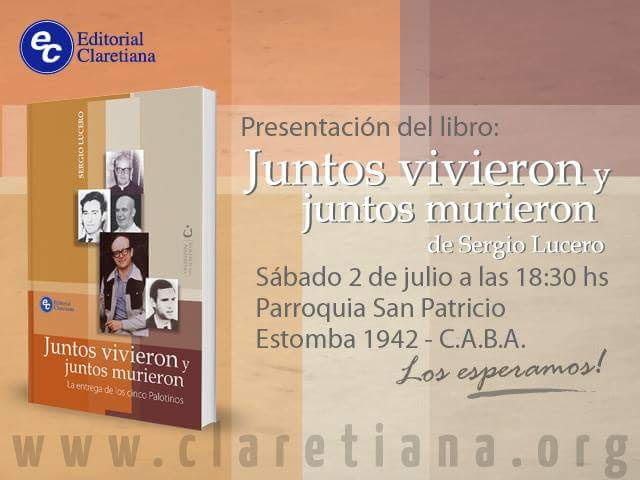
• Sábado 2 Julio, 18.30 hs., Parroquia San Patricio: Presentación del Libro “Juntos vivieron y juntos murieron” de Sergio Lucero, Editorial Claretiana.

• Domingo 3 Julio, desde la ex Capilla Stella Maris –Espacio Patrick Rice de la ex ESMA hasta la Parroquia San Patricio, 17 hs.: Camino del Martirio.
En cada una de las 5 paradas se evocará a uno de los palotinos asesinados:
1. ESMA ex Capilla Stella Maris-Espacio Patrick Rice, recuerdo de Emilio Barletti;
2. Parroquia SAN BONIFACIO, Cuba 2981, Centro de Espiritualidad Palotina, recuerdo de Salvador Barbeito;
3. Parroquia INMACULADA CONCEPCIÓN (“la Redonda de Belgrano”) Vuelta de Obligado y Juramento, recuerdo de Alfredo Leaden;
4. Parroquia NUESTRA SEÑORA DE LOURDES, Monroe y Freire, recuerdo de Pedro Dufau, y
5. Parroquia SAN PATRICIO, recuerdo de Alfie Kelly.

• Lunes 4 Julio, parroquia San Patricio, Echeverría y Estomba: VIGILIA, 8 hs. Oración continua en el interior del templo ̸  MISA, 20 hs, preside Cardenal Mario Poli, concelebra el nuncio apostólico en la Argentina Monseñor Paul Tscherrig, y los siguientes obispos que confirmaron su presencia monseñor Fernando Maletti (obispo de Merlo-Moreno), monseñor Jorge Lozano (obispo de Gualeguaychú), monseñor Alejandro Giorgi (obispo auxiliar de Bs.As. y vicario de Belgrano), monseñor Enrique Eguía Seguí (obispo auxiliar de Bs.As. y Pro Vicario Gral. de la arquidiócesis de Buenos Aires).

Cuarenta años pasaron desde aquel 4 de julio de 1976 y, desde la Comisión organizadora y la comunidad palotina en Argentina sostienen que “nos encontramos con dos certezas: ‘los cinco’ entregaron sus vidas por fidelidad a Jesús, siendo testigos de los valores que el Evangelio anuncia: el respeto a la vida, la justicia y la paz, y este hecho, desde la perspectiva de la fe, nos impulsa a seguir su camino".

“Esta parroquia ungida por la decisión de quienes juntos vivieron, ungida por la sangre de quienes juntos murieron, nos dice algo a esta ciudad, algo que cada uno tiene que recoger en su corazón y hacerse cargo. Despejar etiquetas y mirar el testimonio”, decía el cardenal Jorge Bergoglio en la misa por el 25° aniversario.

“Juntos vivieron y juntos murieron. Fue un atentado a una comunidad comprometida en el anuncio del Evangelio. El compromiso de fe los llevó a defender el valor de la vida y promover los valores evangélicos de la justicia, de la paz y del compromiso con los indefensos de la humanidad”, se afirma en la Declaración como comunidad palotina ante el 40º Aniversario.

Entendiendo la entrega, despejando etiquetas y mirando testimonios. Este es el espíritu de esta convocatoria.


Compartimos el video del Padre Rodolfo Capalozza,
con su testimonio personal de la Masacre de San Patricio
"Lo primero, ubicarnos en la época. Estamos en la década del 70, la Iglesia vivía toda la euforia postconciliar, la Iglesia en América Latina vivía todo el impulso de los documentos finales de Medellín, (...) que intentaron acercar a América Latina todo el espíritu del Concilio Vaticano II." (Capalozza)


Compartimos el video con el testimonio del P. Jeremy Murphy
"Ellos tuvieron una vida de fe, (...) fueron matados por ser religiosos, sacerdotes, palotinos, católicos, miembros de la Iglesia." "Se están celebrando misas en todas las parroquias palotinas de nuestra provincia en todo el mundo este fin de semana." (Murphy)


Compartimos el video con el testimonio del P. Juan Sebatián Velasco
Sobre la causa de beatificación de "los cinco": "Cuando la causa es de martirio no necesariamente buscamos probar ningún milagro. Lo que tenemos que probar es el martirio. (...) Se supone que quien murió mártir vivió las virtudes heroicas en vida". (Velasco)


Compartimos el video con el testimonio de Francisco Chirichella
"El día domingo 3 de julio, después de haberlo pensado mucho y discernido entre las comunidades (...) decidimos hacer el camino del martirio (...) que tiene por objetivo hacer el camino inverso al que ocurrió hace 40 años en 1976 el 4 de julio." (Chirichella)


Compartimos la nota que dio el Padre Capalozza, al programa Lanata Sin Filtro, segmento compartido con Magdalena Ruiz Guiñazú, por Radio Mitre.

AUDIO de la entrevista que realizó el periodista Gabriel Michi para Radio América al sacerdote Rodolfo Capalozza.


CONTACTO DE PRENSA / Virginia Bonard / 11 5 934 1461
PARA AMPLIAR INFORMACIÓN
www.palotinos4dejulio.com.ar
www.youtube.com/watch?v=sPXUDOfuqiA
Agréganos a tu lista de contactos
Información de Contacto
Para desuscribirse de nuestra lista haga Click Aquí
---

Saturday, 11 January 2014

Novena Prayer To St. Vincent Pallotti

January 14th - 22nd


St. Vincent Pallotti, you were formed and called by God, the Infinite Love.
You answered God's call to serve.
You were there:
  for those seeking forgiveness and counsel,
  for the sick,
  for the youth and the aging,
  for the rich and the poor,
  for the people of every profession and walk of life.
Every person is important to you.

You inspire us to seek God in all things,
Reminding us of our call to be apostles
In the Church and in the world.

Now we call upon you to intercede for us.
Help us to pray. Help us to pray only for what we truly need;
Help us to grow in holiness, to live for the honour of God and for the salvation of our neighbour. You received many graces from God and we ask you to bless us now by presenting our petitions to God (Pause to mention your intentions)

With you we give thanks to God as if He had already granted us what we have asked in the name of Jesus who lives and reigns with the Father in the unity of the Holy Spirit forever and ever. Amen!

St. Vincent Pallotti, pray for us
Our Lady Queen of Apostles, pray for us


Our Father…Hail Mary…Glory be...


Friday, 10 May 2013

OUR LADY QUEEN OF APOSTLES - Saturday After Ascension


Mary, Queen of Apostles

Mary is Queen of Apostles because she was chosen to be the Mother of Jesus Christ and to give him to the world; she was made the apostles' Mother and our own by our Savior on the cross. She was with the apostles while awaiting the descent of the Holy Spirit, obtaining for them the abundance of supernatural graces they received on Pentecost. The most holy Virgin was and always will be the wellspring for every apostolate.
She exercised a universal apostolate, one so vast that it embraced all others. The apostolate of prayer, the apostolate of good example, the apostolate of suffering--Mary fulfilled them all. Other people have practiced certain teachings of the Gospel; Mary lived them all. Mary is full of grace, and we draw from her abundance.
Mary attracts the zealous to the various apostolates, then protects and defends all these works. She sheds on each the warmth of her love and the light of her countenance. She presented Jesus in a manner unparalleled throughout the ages. Her apostolate is of the highest degree--never to be equaled, much less surpassed.
Mary gave Jesus to the world and with Jesus came every other blessing. Thus, because of Mary we have the Church: "Mary is the Mother of the Church not only because she is the Mother of Christ and his most intimate associate in 'the new economy when the Son of God took a human nature from her, that he might in the mysteries of his flesh free man from sin,' but also because 'she shines forth to the whole community of the elect as a model of the virtues' (Lumen Gentium. 55, 65). She now continues to fulfill from heaven her maternal function as the cooperator in the birth and development of the divine life in the individual souls of the redeemed" (The Great Sign, by Paul VI). What do we have of value that we have not received through Mary? It is God's will that every blessing should come to us through her.
Because the Blessed Mother occupies a most important position in God's plan of salvation, all humanity should pay homage to her. Whoever spreads devotion to the Queen of Apostles is an apostolic benefactor of the human race, because devotion to Mary is a treasure. Blessed is the person who possesses this treasure! Mary's devotees will never be without grace; in any danger, in every circumstance they will always have the means to obtain every grace from God.
Several religious congregations practice devotion to Mary under the title of Queen of Apostles, including the Pallotines, the Marianists, and the congregations founded by Bl. James Alberione (the Society of St. Paul, the Daughters of St. Paul, and several others). In the twentieth century, Bl. Alberione promoted this devotion in a particular way.
— Excerpted from Favorite Prayers and Novenas, copyright 1997 Pauline Books & Media

Friday, 22 March 2013

REFLECTION ON POPE FRANCIS' INAUGURAL HOMILY

 He Who Serves With Love Is Able To Protect
Clara reflexión del provincial de los palotinos en Irlanda
· Dublin, 19 March 2013 (Zenit.org) Redacción | 235 hitos
By Fr. Derry Murphy SAC, Provincial Irish Province of the Mother of Divine Love
Together with the entire Church I give thanks to God for Pope Francis and for our Emeritus Pope Benedict.
The homily preached by Francis today is faithful to his preaching style, it is profound, anchored in the Word of God, centered on God and on our concrete response to it in daily life; and it is, as always, concise.
It indicates to us in clear steps how he is living this call; he begins by giving thanks to God, then speaks of having ‘listened to’ the Word proclaimed in the Mass and then directly enters into the central theme: ‘to be a ‘custos’ a ‘protector’, his true vocation following the example of St. Joseph.
He emphasizes his awareness that the vocation and the responsibility to be a ‘protector’ is one shared by all people, and that it embraces all people and all that God has created, all that lives on this earth. In living this common vocation to be protectors of the gifts of God he warns us of the dangers which emerge, they are the fruit of sin and result in destruction and wreak havoc in human life.
He affirms that he is nourished by the call he has received and by the power which accompanies it and which is a vocation to service. In quoting the words of Jesus to Peter ‘feed my lambs, feed my sheep’ he is very clear; and this gives rise to the hope of which he spoke and which will characterize his Papacy.
The affirmation that ‘only the person who serves with love is able to be a protector’ is an unequivocal message to the world.
In conclusion, the language Pope Francis uses, the repetition of the words ‘tenderness’, ‘love’, ‘hope’, ‘service’, ‘protector - to protect’, ‘God’ and ‘Mary’, the phrases ‘to protect Jesus with Mary’, to ‘be protectors of God’s gifts (and not owners)’, or ‘tragically in every period of history… there are ‘Herods’, issue to us a strong challenge to live all this in our common vocation and in communion with him. 
I leave the final words to Pope Francis, words which speak for themselves: To protect … especially the poorest… this is a service that the Bishop of Rome is called to carry out, yet one to which all of us are called, so that the star of hope will shine brightly… and I ask all of you to pray for me! Amen.

P. Derry Murphy, SAC
Provincial de la Provincia Madre del Divino Amor (Provincia Irlandesa) de los Palotinos y
Presidente de la Unión del Apostolado Católico.
(19 de marzo de 2013) © Innovative Media Inc.